Music Ambassadors
A Music Ambassador is a pupil who helps promote and support music across the school. Their main role is to act as a leader, helper, and advocate for musical activities. A Music Ambassador helps make music more visible, enjoyable, and accessible to everyone in the school community.
Role Description - Main Responsibilities
Promote a Love for Music:
- Encouraging other pupils to take part in singing, playing instruments, and musical events.
Support Learning Across the School:
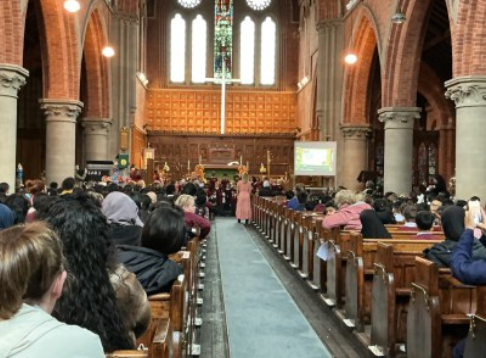
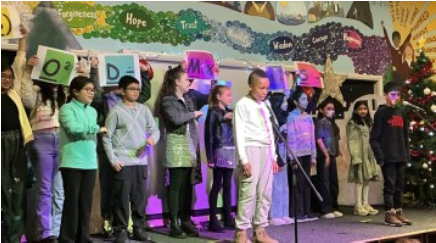
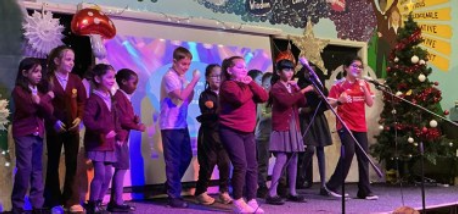
- Help teachers with Music themed events such as the Christmas Carol service, the termly talent shows, singing assemblies etc.
- Help teachers set up for music lessons.
Assist with Music Club:
- Support teachers in running an EYFS Music club by helping set up resources, encouraging pupil participation, and suggesting engaging topics or activities.
- Help promote the club to other pupils and gather feedback on what they enjoy or want to learn more about.
Represent Pupil Voice:
- Gather feedback from classmates about what they enjoy in Music lessons and what could be improved.
- Attend regular meetings with the Music subject lead or school council to share ideas and feedback.
Help with Resources:
- Help with the maintaining of resources and stock take and general tidy up of the Music cupboard.
Celebrate Musical Achievements:
- Recognise and celebrate achievements in Music successes across the school (e.g., Violin tutorials, guitar club)
- Help promote diversity in Music by highlighting different cultures, viewpoints, and historical figures.
Model Good Learning Habits:
- Demonstrate curiosity, enthusiasm, and critical thinking during Music lessons.
- Set a good example by showing a respectful attitude to different musical perspectives.
What Makes a Good Music Ambassador?
- Passionate about music - enjoys singing, playing instruments, and listening to different kinds of music.
- Confident performer - willing to take part in assemblies, concerts, and other school events.
- Helpful and responsible - supports teachers by setting up equipment or helping younger pupils
- Positive role model - shows enthusiasm, good behaviour, and encourages others to join in.
- Good communicator - listens to others’ ideas and shares them clearly with teachers.
- Creative thinker - suggests new musical activities or ways to make music more fun in school.
- Reliable and organised - remembers duties, attends rehearsals, and takes the role seriously.
- Encouraging and kind - helps others feel confident and included in music-making.
- Team player - works well with classmates, teachers, and other ambassadors.
Meet Our Music Ambassadors
.jpeg)
Isabella
Year 4
When I grow up I want to be a singer and I am in the choir. Singing is my favourite thing to do and I love music lessons in school.
.jpeg)
Mason
Year 4
I like listening to music and I like singing. My favourite song is ‘Believe me’ and I like Justin Bieber.
.jpeg)
Khadijah
Year 5
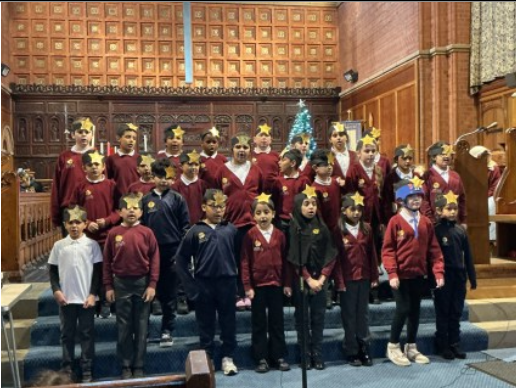
Music makes me happy. I enjoy using instruments and singing songs and performing in the choir for the Harvest festival and the Christmas Carol Service.
.jpeg)
Falmata
Year 5
I like listening to songs and feeling the melody that flows through my body like water waves. I love playing instruments like the piano or the guitar.
Music Curriculum, Teaching & Learning and Assessment Outcomes
Curriculum
At St Thomas’ music is an important contribution to the life of our school and is celebrated, promoted and encouraged. It helps build pupils’ self-esteem and self-discipline and leads to higher standards across the curriculum. St Thomas’ embraces and acknowledges the transformational power that music brings to pupils, staff and parents alongside the wider whole school community. We believe that music: boosts pupil social development, it improves learning skills, it fosters team working, builds life skills, underpins better behaviour, encourages creativity, it is an educational building block, it is for life, it is fun and it is for everyone.
...Music is an essential part of a broad and ambitious curriculum for all pupils. It must not be the preserve of the privileged few. Music should be planned and taught as robustly as any other foundation curriculum subject, as exemplified in the Model Music Curriculum we published last year. (The Power of Music to Change Lives, DfE June 2022, page 4)
At St Thomas’, our music curriculum in the Early Years is designed to ignite children’s natural curiosity and enthusiasm for sound, rhythm, and self-expression. Through playful, inclusive, and hands-on experiences, we aim to nurture a lifelong love of music.
Teaching & Learning
At St Thomas, our music curriculum is implemented through a structured, progressive, and inclusive approach that ensures all children, from Early Years through to Year 6, receive a high-quality music education. As Music Coordinator, I work alongside teachers, leaders, and external specialists to create a music curriculum that is accessible, engaging, and rooted in the National Curriculum.
Curriculum Design
We follow a progressive scheme of work based on the National Curriculum, ensuring clear skill progression in the interrelated dimensions of music: performing, composing, listening, and appraising. In Early Years, music is integrated into daily routines and continuous provision, supporting the EYFS framework. In Key Stages 1 and 2, lessons are delivered weekly using a combination of:
- Published schemes (Sparkyard)
- Specialist teacher-planned and led units based on thematic or cross-curricular links (from Bolton Music Service)
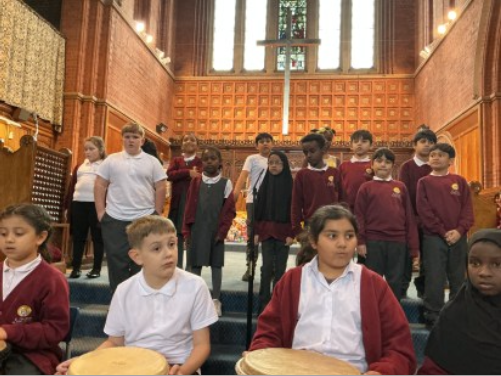
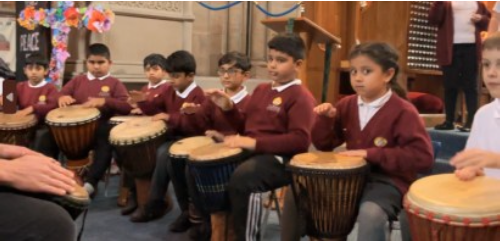
- Whole-class instrumental teaching (Y3 - Glockenspiels and Y4 Djembes)
Each year group builds upon prior knowledge, developing musical vocabulary, technical skills, and creativity.
Wider Opportunities:
- LKS2 pupils participate in whole-class instrumental tuition through the local Music Hub (Glockenspiels and Djembes from Bolton Music Service).
- Extracurricular clubs include choir, Drum kit lessons, guitar lessons and recorders.
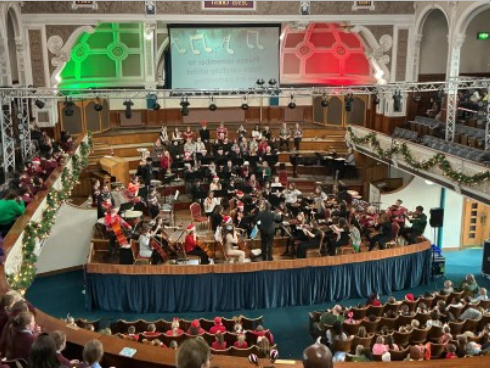
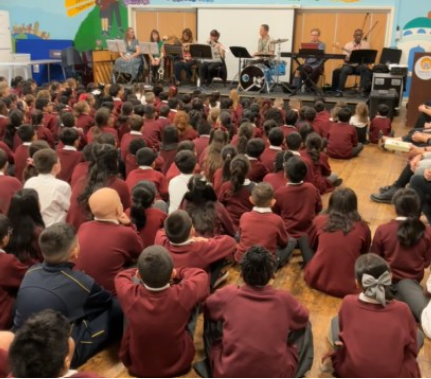
- Regular performance opportunities such as assemblies, school concerts, and local community events celebrate pupils’ achievements.
Assessment
Assessment is ongoing and formative, focusing on pupils’ engagement, skill progression, and understanding of musical concepts. Summative assessments at key points track progress and inform planning.
Staff Development
The coordinator, working alongside Bolton Music Service specialist teachers, provides CPD and resources to support non-specialist teachers in delivering high-quality music lessons and builds confidence across the teaching team.
Music at St Thomas’ is a vital part of our curriculum and contributes strongly to children’s personal development, creativity, and cultural awareness. As Music Coordinator, I am committed to ensuring that all children experience the joy of music and are given the opportunity to grow as confident, expressive musicians.
Assessment Outcomes
The impact of our music curriculum is reflected in the enthusiasm, confidence, and creativity of our pupils. By the end of each key stage, children:
- Demonstrate a secure understanding of the interrelated dimensions of music.
- Can perform with increasing accuracy, control, and expression.
- Compose and improvise music with creativity and purpose.
- Listen to and appraise a variety of musical styles with growing awareness and understanding.
Music contributes significantly to pupils’ personal development, enhancing teamwork, resilience, discipline, and emotional expression. Pupils develop cultural awareness and respect through exposure to diverse musical traditions.
Feedback from staff, pupils, and parents highlights the positive role of music in our school’s ethos and community life. Performances and extracurricular opportunities build confidence and pride, fostering a sense of belonging and collective achievement.
The continued growth of musical participation and attainment demonstrates that our intent - to inspire, challenge, and nurture every child through music - is being successfully realised.
Overview of Music
| Autumn 1 | Autumn 2 | Spring 1 | Spring 2 | Summer 1 | Summer 2 | |
|---|---|---|---|---|---|---|
| Nursery |
Nursery Rhymes |
Singing songs linked to Christmas in preparation for our Christmas sing along |
‘My Musical classroom’ |
‘Musical patterns and performing’ |
‘Musical patterns and performing’ |
‘Sound stories’ |
| Reception |
Sparkyard ‘My Musical Classroom’ |
Sparkyard Singing songs linked to Christmas in preparation for our Christmas sing along |
Sparkyard Musical Patterns and Performing |
Sparkyard Musical Patterns and Performing |
Sparkyard Sound Stories |
Sparkyard Sound Stories |
| Year 1 | Exploring the natural world through music | The Carnival of the Animals | The Weather | Exploring Orchestral Instruments | Sound | We’re going to the Seaside |
| Year 2 | Carnival Music - Samba | The Carnival of the Animals | The Weather | Exploring Orchestral Instruments | Sound | We’re going to the Seaside |
| Year 3 | Glockenspiels - ‘Bell Play’ - (Using the Glockenspiels to learn about Pulse, Rhythm, Pitch improvisation) | Glockenspiels - ‘Bell Play’ - (Using the Glockenspiels to learn about Pulse, Rhythm, Pitch improvisation) | Djembe - ‘We are musicians’ (Using the Djembe’s to develop multipart playing, reading notation and improvising) | Djembe - ‘We are musicians’ (Using the Djembe’s to develop multipart playing, reading notation and improvising) |
Sparkyard Sing, Play, Notate! |
Sparkyard Sing, Play, Notate! |
| Year 3/4 |
Sparkyard Hear it, Play it! Exploring rhythmic Patterns |
Sparkyard Hear it, Play it! Exploring rhythmic Patterns |
Glockenspiels - ‘Bell Play’ - (Using the Glockenspiels to learn about Pulse, Rhythm, Pitch and improvisation) | Glockenspiels - ‘Bell Play’ - (Using the Glockenspiels to learn about Pulse, Rhythm, Pitch and improvisation) | Djembe - ‘We are musicians’ (Using the Djembe’s to develop multipart playing, reading notation and improvising) | Djembe - ‘We are musicians’ (Using the Djembe’s to develop multipart playing, reading notation and improvising) |
| Year 4 | Year 4 - Djembe - ‘A journey to Africa’ (Using the Djembe’s to learn about Pulse, Rhythm, pitch and improvisation) | Year 4 - Djembe - ‘A journey to Africa’ (Using the Djembe’s to learn about Pulse, Rhythm, pitch and improvisation) |
Sparkyard Musical Contrasts |
Sparkyard Musical Contrasts |
Glockenspiels - ‘We are musicians’ - (Using the Glockenspiels to develop multipart playing, reading notation and improvising) | Glockenspiels - ‘We are musicians’ - (Using the Glockenspiels to develop multipart playing, reading notation and improvising) |
| Year 5 | Rhythm revisers, renewers and brand newers (beat, walk, jogging, stride, rests, running faster, running fast, run faster) | Rhythm revisers, renewers and brand newers (beat, walk, jogging, stride, rests, running faster, running fast, run faster) | Jazz classroom | Jazz classroom | Pitch 2 | Pitch 2 |
| Year 5/6 | Rhythm revisers, renewers and brand newers (beat, walk, jogging, stride, rests, running faster, running fast, run faster) | Rhythm revisers, renewers and brand newers (beat, walk, jogging, stride, rests, running faster, running fast, run faster) | Jazz classroom | Jazz classroom | Pitch 2 | Pitch 2 |
| Year 6 | Rhythm revisers, renewers and brand newers (beat, walk, jogging, stride, rests, running faster, running fast, run faster) | Rhythm revisers, renewers and brand newers (beat, walk, jogging, stride, rests, running faster, running fast, run faster) | Jazz classroom | Jazz classroom | Pitch 2 | Pitch 2 |
Progression of Skills in Music
Skills Progression - Singing
| Year 1 | Year 2 | Year 3 | Year 4 | Year 5 | Year 6 |
|---|---|---|---|---|---|
| Sing simple songs, chants and rhymes with a small pitch range from memory, singing collectively and at the same pitch. | Sing a variety of songs with a wider pitch range (do-do) showing a sense of melodic shape. | Sing a widening range of unison songs of varying styles and structures, tunefully and with expression. | Continue to sing a broad range of unison songs within an appropriate vocal range with clear diction, mostly accurate tuning and control of breathing. | Sing within an appropriate vocal range with clear diction, accurate tuning, control of breathing and phrasing and communicating an awareness of style. | Sing a broad range of songs within an appropriate vocal range, with clear diction, accurate tuning, control of breathing and phrasing and communicating an awareness of style. |
| Sing so-mi songs and singing games with accurate pitch matching. | Sing la-so-mi songs and singing games with accurate pitch matching. | Perform actions and body percussion confidently and in time to a range of action songs | Sing canons, rounds and other partner songs with increased control. | Sing three-part rounds, partner songs, and songs with different structures. | Sing three and four part rounds and simple harmony lines, showing an awareness of how the parts fit together. |
| Respond to simple visual directions (e.g. stop, start, loud, quiet) and counting in. | Know the meaning of dynamics (loud/quiet) and tempo (fast/slow) and demonstrate these when singing and playing. | Experience singing canons, simple rounds and other partner songs. | Show control of dynamics, tempo and articulation when singing and playing, following physical signals and written symbols: (p f < > crescendo, decrescendo, accelerando, rallentando, staccato, legato). | Confidently and appropriately make use of dynamics, tempo and articulation when performing, following physical signals and written symbols (pp p mp mf f ff < > accelerando, rallentando, staccato, legato). | Refine use of dynamics, tempo and articulation when performing, following physical signals and written symbols (pp p mp mf f ff < > accelerando, rallentando, staccato, legato). |
| Explore using the voice expressively and creatively. | Explore using the voice expressively and creatively. | Show control of dynamics and tempo when singing and playing, following physical and written symbols: dynamics - p f (loud/soft); tempo -allegro, adagio (fast/slow). | |||
|
Begin to use the ‘thinking’ voice. |
Internalise a steady pulse e.g. use the ‘thinking voice’ to ‘sing’ short extracts in own head. |
|
|
|
|
| Sing short phrases independently within a singing game or short song. |
Skills Progression - Listening
| Year 1 | Year 2 | Year 3 | Year 4 | Year 5 | Year 6 |
|---|---|---|---|---|---|
| Listen to a range of recorded and live music express own opinion about the music. | Listen with greater concentration to a range of recorded and live music and express own opinion about the music. | Listen with increasing concentration and recognise how the inter related dimensions of music can be used to create different moods and effects. | Listen with increasing concentration and describe how the inter related dimensions of music can be used to create different moods and effects. |
Listen with attention to detail and recall sounds with increasing aural memory. |
Listen with attention to detail and recall sounds with increasing aural memory. |
| Recognise and respond to changes in dynamics, tempo and timbre. | Recognise changes in dynamics, tempo and timbre and explain in simple ways how these changes affect the music. | Appreciate and understand a growing range of live and recorded music drawn from different traditions and historical periods and from great composers and musicians. | Appreciate and understand a growing range of live and recorded music drawn from different traditions and historical periods and from great composers and musicians. | Appreciate and understand a wide range of live and recorded music drawn from different traditions and historical periods and from great composers and musicians. |
Appreciate and understand a wide range of live and recorded music drawn from different traditions and historical periods and from great composers and musicians. |
| Name some common hand held percussion instruments and recognise their sounds aurally. | Name an increasing number of hand held percussion instruments and recognise their sounds. | Recognise the different instrumental families when watching musical performances and begin to recognise the sounds they make. | Recognise the different instrumental families when watching musical performances and begin to recognise the sounds they make. | Recognise and name a growing number of individual instruments within instrumental families. | Recognise and name a growing number of individual instruments within instrumental families. |
| When listening to music, recognise the difference between major and minor. | Describe, compare and evaluate different pieces of music using appropriate musical vocabulary. | Describe, compare and evaluate different pieces of music using appropriate musical vocabulary. | |||
| Begin to relate music across time to other factors such as world events and to develop a basic idea of a musical timeline. |
Begin to relate music across time to other factors such as world events and to develop a basic idea of a musical timeline. |
Skills Progression - Composing
| Year 1 | Year 2 | Year 3 | Year 4 | Year 5 | Year 6 |
|---|---|---|---|---|---|
| Improvise | |||||
| Improvise simple vocal chants, using question and answer phrases. | Work with a partner to improvise simple question and answer phrases, (using voices and instruments) creating a musical conversation. | Improvise (using voices and instruments), inventing short ‘on the-spot’ responses using a given note range. | Become more skilled in improvising on a given note range (using voice and instruments) | Improvise freely, (e.g. over a simple groove), responding to the beat, developing a sense of shape and character, (using voice, body percussion and instruments). | Continue to improvise freely over a simple groove, responding to the beat, developing a sense of shape and character (using voice, body percussion and instruments). |
| Use improvisations within more structured composition work | |||||
| Compose | |||||
| Explore body, vocal and percussion sounds to create musical sound effects and short sequences of sounds in response to stimuli, e.g. a rainstorm, or to enhance story telling. | Create music as a response to a stimulus e.g. a rocket launching, a rockpool etc. choosing and using appropriate instruments to represent ideas. | Compose in response to different stimuli, e.g. stories, images and musical sources, thoughtfully using the inter-related dimensions of music to create specific effects and atmospheres, and record using standard and graphic notation. | Compose in response to different stimuli, e.g. stories, images and musical sources, thoughtfully using the inter-related dimensions of music to create specific effects and atmospheres, and record using standard and graphic notation. |
Compose music for a range of purposes, confidently and appropriately using the inter-related dimensions of music to create specific effects, moods, atmospheres and ideas. |
Compose music for a range of purposes, confidently and appropriately using the inter-related dimensions of music to create specific effects, moods, atmospheres and ideas. |
| Explore and understand the difference between creating a rhythm pattern and a pitch pattern. | Experiment with, select, combine and sequence sounds using the inter related dimensions. | Structure musical ideas to create music that has a beginning, middle and end. | Structure musical ideas to create music that has a beginning, middle and end. | Plan and compose an 8 beat melodic phrase using the pentatonic scale (e.g. C D E G A) and incorporate rhythmic variety and interest. Play this melody on tuned percussion and/or melodic instruments. |
Explore the difference between major and minor by using a 5 note set starting on C (major) and D (minor); compose simple question and answer phrases using the note set and play on tuned percussion and/or melodic instruments. |
| Begin to create rhythms using words and phrases as a starting point. | Create rhythms using words and phrases as a starting point. | Begin to compose simple rhythmic patterns and song accompaniments on untuned percussion using crotchets (walk), paired quavers (jogging) and crotchet rests. | Compose rhythmic patterns using crotchets, paired quavers, minims and crotchet rests to create sequences of 2-, 3- or 4-beat phrases. | Combine short compositions to create a class piece, exploring different structures. | Capture and record creative ideas in different ways e.g.: graphic symbols, rhythm notation, staff notation and music technology. |
| Recognise how graphic notation can represent created sounds and explore and invent own symbols. | Use graphic symbols, dot notation and stick notation, as appropriate, to keep a record of compositions. | Combine known rhythmic notation with letter names to create rising and falling phrases using just three notes. | Combine known rhythmic notation with letter names to create short phrases using a limited range of pitches appropriate to the instrument. | Capture and record creative ideas in different ways e.g.: graphic symbols, rhythm notation, staff notation and music technology. |
Make improvements to my own work, giving reasons using appropriate musical vocabulary. |
| Use music technology (where available) to capture, change and combine sounds. | Use music technology (where available) to capture, change and combine sounds. | Explore and develop using Music Technology (where available) to capture, change and combine sounds. | Explore and develop using Music Technology (where available) to capture, change and combine sounds. | Make improvements to my own work, giving reasons using appropriate musical vocabulary. | |
| Make improvements to own work, giving reasons for changes made. | |||||
Skills Progression - Musicianship & Performing
.png)
.png)
.png)
Music in the Early Years
Music in the early years is, at first, exploratory and sensory. Children are encouraged to respond to sounds and music and offer their thoughts and feelings about it. Songs are shared, learned and created! Children explore pitch, rhythm and melody in many ways including the use of the Sparkyard scheme. Children use instruments to express their feelings and ideas and are encouraged to perform both as a soloist and in groups. Singing is embedded into every area of the Early Years curriculum, including Maths, Literacy and Topic
Skills Developed
- Recognising loud/soft, fast/slow, high/low sounds.
- Keeping a steady beat.
- Beginning to sing in tune.
- Developing confidence and teamwork through group performances.
- Understanding basic musical vocabulary (beat, rhythm, pitch, dynamics).
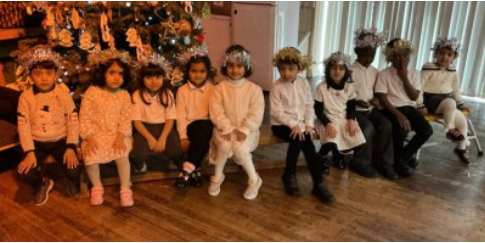
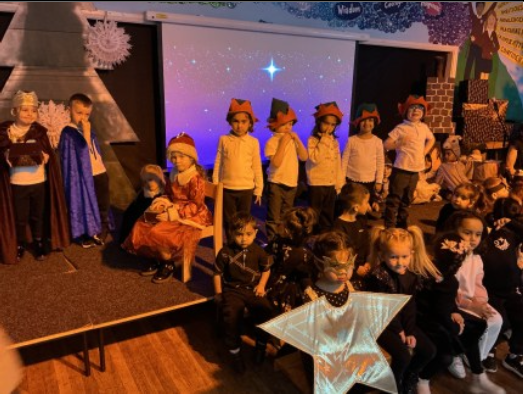
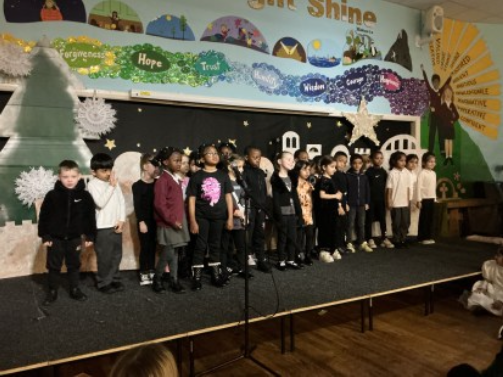
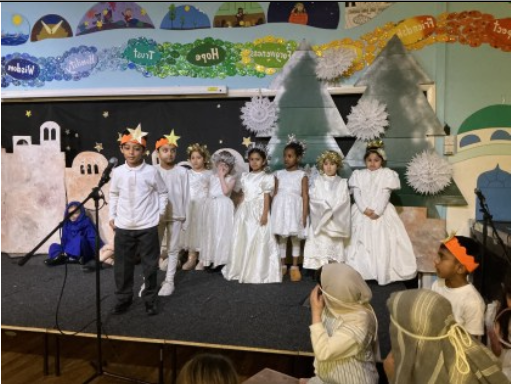
Achievements & Celebrations in Music