Writing Ambassadors
A Writing Ambassador acts as a pupil representative and champion for their subject. Their role is to help promote enthusiasm for writing across the school, support staff in developing learning, and give pupils a voice in shaping how writing is taught.
Role Description - Main Responsibilities
Promote a Love for Writing:
- Organise fun writing activities like story competitions or collaborative class books to inspire creativity and excitement about writing.
- Celebrate and share writing achievements by displaying students’ work around school or reading pieces in assemblies to make writers feel proud and valued.
Support Learning Across the School:
- Help younger pupils with their writing, offering encouragement and tips during writing sessions or clubs.
- Work with teachers to share ideas and feedback, helping to make writing lessons engaging and enjoyable for everyone.
Assist with Writing Clubs:
- Support the running of writing clubs by helping to plan fun activities, games, and creative writing challenges.
- Encourage and mentor other pupils, giving positive feedback and helping them develop their ideas and confidence in writing.
Represent Pupil Voice:
- Collect feedback from classmates about what they enjoy in writing and share their ideas with teachers to help improve writing activities.
- Speak on behalf of pupils in meetings or assemblies, making sure everyone’s opinions about writing are heard and valued.
Help with Displays and Resources:
- Help create and update writing displays, showcasing pupils’ work and celebrating different writing styles and achievements.
- Organise and maintain writing resources, such as word mats, dictionaries, and inspiration boxes, to support others during writing lessons.
Celebrate Writing Achievements:
- Announce and share writing successes in assemblies or newsletters.
- Display outstanding work around the school to inspire others.
Model Good Learning Habits:
- Show enthusiasm and effort in all writing tasks.
- Demonstrate perseverance by editing and improving their work.
What Makes a Good Writing Ambassador?
- Passionate about writing and eager to inspire others.
- Supportive and encouraging towards all learners.
Meet Our Writing Ambassadors
.jpeg)
Victoria
Year 6
I wanted to be a Writing Ambassador because I enjoy writing and helping others to improve. Writing is important because it helps us share our ideas clearly. I wanted to be a role model and encourage other pupils to feel confident about their writing. My favourite part is helping other children improve their writing and seeing them feel proud of their work. I also enjoy having responsibility and being trusted to support others.
.jpeg)
Aaisha
Year 6
The reason that I wanted the renowned role of being Writing Ambassador is because I write for pleasure. Writing is critical life skill which everyone needs to be able to do and some people might need help. Then the writing ambassadors help them. I love helping people and writing can be fun and interesting and creative. By being a part of the writing ambassadors you can be known for writing throughout the school.
.jpeg)
Joyeuse
Year 6
I wanted to be a Writing Ambassador because writing was always one of my favourite subjects and I find it relaxing to write a story. When the opportunity to apply for the role came out, I knew I wanted it. I loved helping people to love writing the way that I do.
.jpeg)
Madeeha
Year 6
I wanted to be a Writing Ambassador because I wanted to help little ones that love writing improve their writing. I am happy that I am an ambassador because we do clubs at lunch now and I can see the children that attend have made progress. My favourite thing about being a writing ambassador is that we get to introduce poem competitions, write stories and, best of all, help people to improve.
Writing Curriculum, Teaching & Learning and Assessment Outcomes
Curriculum
At St. Thomas’ School, we are committed to improving writing outcomes across the entire school, striving for excellence at every stage of pupils' learning. Through the Talk for Writing approach, we aim to ignite pupils’ creativity and inspire a lifelong passion for written expression, with a relentless focus on improvement. Our writing curriculum seeks to:
- Develop Purpose, Audience, and Form: Pupils will learn to understand how purpose, audience, and form shape writing across a variety of genres, and continually strive to improve their ability to write for different purposes and audiences.
- Build Confidence and Individuality: We foster confidence in all pupils, encouraging them to express their ideas with clarity, imagination, and precision, while pushing for improvement in their written expression.
- Foster Critical Thinking and Reflection: Through planning, editing, and refining their work, pupils will be encouraged to think critically and reflect on how language choices impact meaning, supporting a continuous improvement cycle in their writing.
- Promote Essential Writing Skills: Emphasis is placed on improving key skills such as spelling, grammar, punctuation, and vocabulary, ensuring pupils can communicate effectively and make connections between their reading and writing.
Foundations in Early Years: In Early Years, we lay the foundation for writing through play-based learning, where children engage in storytelling, mark-making, and drawing - setting the stage for continuous improvement in writing as they progress through the school.
Teaching & Learning
To ensure whole-school improvement in writing, we implement a dynamic and well-structured writing curriculum that builds progressively from Early Years to Year 6, with a shared commitment to improvement. Key elements of our teaching and learning approach include:
-
Curriculum Design
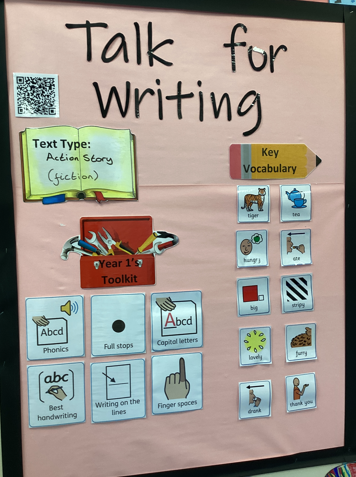
Our writing curriculum is designed to build writing skills progressively, with a strong focus on continual improvement. Talk for Writing underpins this process, with pupils working through the phases of Imitation, Innovation, and Independent Application. Each phase supports pupils in refining and improving their writing skills. In Early Years, mark-making, drawing, and storytelling provide the foundation for later writing development.
-
Teaching Strategies
Our teaching strategies incorporate Talk for Writing methods, including storytelling, shared writing, role-play, and discussion. Pupils engage in oral rehearsal before writing, helping them refine and improve their ideas. Teachers model the writing process and encourage pupils to strive for improvement through planning, drafting, and editing, applying new vocabulary, grammar, and writing techniques to their work.
-
Experiential Learning
Writing projects are connected to real-world experiences, such as creating letters, reports, or class books based on trips or community events. These experiences help make writing meaningful, motivating pupils to improve their writing skills by writing for real audiences. In Early Years, storytelling, mark-making, and collaborative writing tasks support children in developing early writing skills that are built upon throughout their school journey.
-
Adaptive Teaching
We are committed to ensuring that every pupil, regardless of ability, can progress in writing. Differentiated resources and scaffolded support are provided, particularly in the Talk for Writing process. Teachers use formative assessments to provide targeted support and guidance, ensuring every pupil has the opportunity to improve and meet their individual potential.
-
Handwriting
Handwriting is taught explicitly and systematically using the ‘PenPals’ for Writing scheme and is delivered separately from writing lessons. This ensures pupils develop secure handwriting knowledge and motor skills, enabling them to write fluently and focus on the composition and quality of their written work. The school places a strong emphasis on consistent handwriting practice through the explicit teaching and reinforcement of the 3Ps: posture, position and pen/pencil grip. These expectations are modelled by staff, verbally reinforced before all writing tasks, and displayed in every classroom to promote consistency and independence. As a result, pupils develop increasing fluency, stamina and pride in the presentation of their work.
-
Spelling
Spelling is taught in line with the requirements of the national curriculum, with a clear progression of knowledge and skills across year groups. Pupils receive regular, structured spelling instruction and are supported to apply their spelling knowledge accurately within their writing. Regular spelling assessments are used to monitor pupils’ progress, identify misconceptions and inform targeted teaching, ensuring that pupils make strong and sustained progress over time.
-
Assessment and Feedback
Formative assessment is key to tracking pupils’ progress and ensuring continuous improvement. Teachers provide timely, constructive feedback, encouraging pupils to reflect on their writing and make revisions. This feedback loop helps pupils understand how to improve their work, fostering a growth mindset and a focus on improvement. Data is used to track progress against national curriculum expectations and inform next steps.
Assessment Outcomes
The impact of our Writing curriculum is measured through various outcomes and indicators:
-
Pupil Engagement and Enthusiasm
Observations show high levels of engagement and enjoyment during writing lessons. Many pupils express excitement about creating stories, experimenting with language, and sharing their ideas.
-
Knowledge Retention and Understanding
Assessment data indicates pupils consistently achieve age-related expectations in writing. They demonstrate an understanding of different genres, structures, and conventions, often making connections to prior learning and reading.
-
Skills Development
Pupils leave St Thomas’ with well-developed writing skills, including planning, drafting, editing, and crafting coherent and creative texts. These skills prepare them for secondary education and beyond.
In Early Years, children develop emerging writing abilities through mark-making, storytelling, and simple composition activities.
-
Cultural Awareness and Identity
Through writing, pupils explore diverse perspectives and experiences, fostering empathy, respect, and an appreciation for cultural diversity. This supports the promotion of British Values, including mutual respect and tolerance.
-
Community Involvement
Writing projects often connect with the local community, such as class books, letters, or collaborative projects, enhancing relevance and encouraging pupils to engage with real-world contexts.
In summary, our intent, implementation, and impact statements reflect our commitment to delivering an outstanding Writing curriculum that meets national standards while nurturing confident, creative, and thoughtful writers prepared to express themselves effectively and engage meaningfully with the world around them.
Overview of Writing
.png)
Progression of Skills in Writing
.png)
Writing in the Early Years
In the Early Years Foundation Stage, writing is a key part of the Literacy area of learning. It is closely linked to children’s communication, language, and early reading skills. Writing in the EYFS is about developing a love of mark making, stories, and imaginative play, as well as building the foundations for forming letters, building sentences, and expressing ideas.
Children learn that writing carries meaning by exploring marks, symbols, signs, and environmental print in meaningful contexts. They enjoy creating stories with adults, joining in with oral retelling and predicting what might happen next. Through these shared experiences, children begin to understand how stories work and to talk about characters, settings, and events before attempting to write their own ideas.
As children’s language and listening skills develop, they engage in conversations about what they have written or plan to write, expressing preferences and making connections to their own experiences. Practitioners encourage this by modelling writing, using story maps, and showing genuine enjoyment when creating and sharing texts with children.
Early writing also involves developing phonological awareness - listening for rhymes, rhythms, and sounds in words. As children progress, they are introduced to systematic phonics to help them link sounds (phonemes) to letters (graphemes) and begin to write simple words.
Through daily story time, rhymes, modelled writing, and phonics sessions, children learn to:
- Listen to and join in with familiar stories and poems
- Recognise that marks and print convey meaning and are written from left to right, top to bottom
- Identify and talk about favourite characters and events
- Hear and identify sounds in words
- Begin to segment sounds to write simple words
- Use new vocabulary from stories in their own speech, play, and writing
Teaching staff create a language-rich environment with inviting writing areas, mark-making resources, and opportunities for children to explore writing independently and with others. Families are encouraged to share stories, support early mark making, and celebrate children’s writing at home, fostering positive attitudes to writing from the earliest age.
Through these experiences, children develop not only the skills needed to become confident early writers but also the joy, curiosity, and imagination that support a lifelong love of writing.
Achievements & Celebrations in Writing
.png)
.png)
%20(1).png)
%20(1).png)
.png)
.png)
.png)
.png)
.png)


.png)